



The Games You May Like













Banana Doh
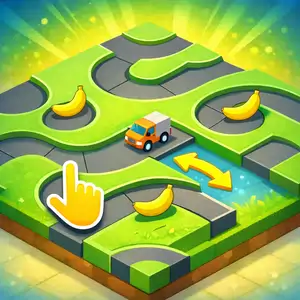
At first glance, it feels like a simple route puzzle—rotate a few streets, grab bananas, done. That assumption didn’t last long. The core mechanic revolves around redirecting street tiles while the car keeps moving, which means your decisions are always slightly delayed in effect. There’s roughly a 0.2–0.3 second window between switching a road and the car actually committing to that path, and that tiny delay ends up being everything.
I kept thinking the car would instantly react—nope, that’s not how it works. It follows momentum, almost like it “locks in” a direction for a split second. Once you realize that, the whole system starts to make more sense. Streets aren’t just paths; they’re timing tools.
The experience swings between oddly relaxing and suddenly stressful. Early levels let you experiment freely, but later ones stack multiple intersections close together. You’re flipping paths while already planning the next turn—mess up once and the car loops uselessly. There was a moment where I muttered “okay, that’s on me” after missing an obvious banana because I switched too late.
Pro tip: don’t chase the nearest banana first. Instead, align two or three future turns ahead so the car flows naturally. It’s less about reacting and more about pre-loading decisions.
I initially blamed randomness when the car kept circling—turns out it was my timing. I was switching roads after the car had already passed the decision point. Once I started flipping tiles slightly earlier (just before the car reaches the junction), the routes became consistent.
One small downside: some later layouts feel a bit cramped, making it harder to read intersections quickly. You might pause—not literally, just mentally—to parse the layout before acting. Still, that pressure is part of the charm.
There’s also a subtle rhythm to it. You begin to feel the cadence of movement—turn, glide, adjust—almost like syncing to an invisible beat. And when everything lines up, the car sweeps through bananas in one clean run. That’s the moment it clicks.